


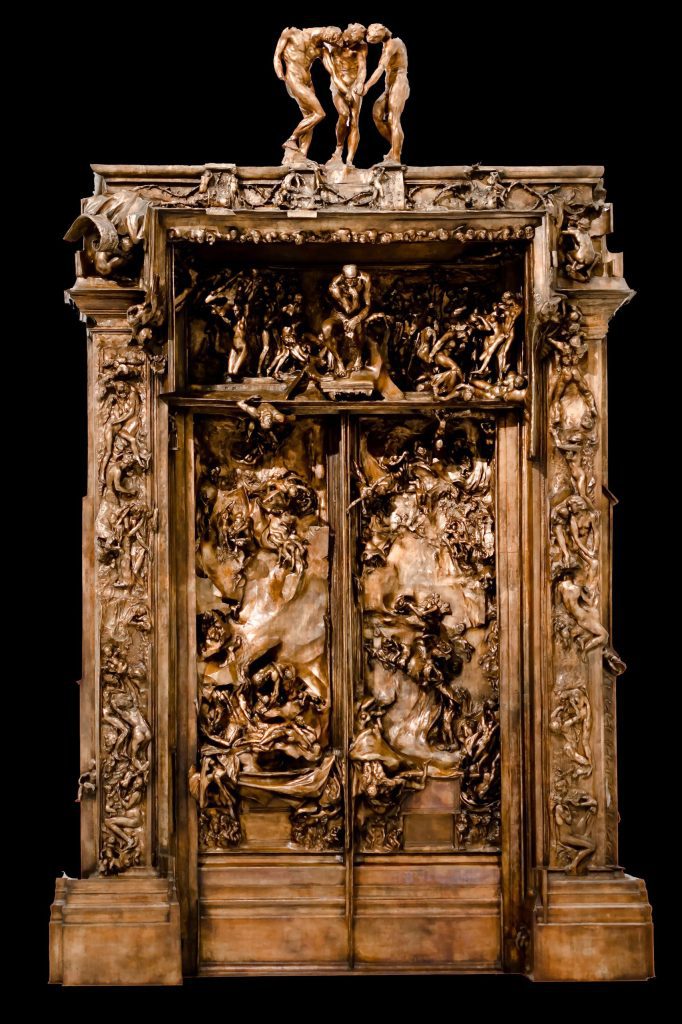
Auguste Rodin’s The Gates of Hell depicts in bronze the damned in Dante’s Inferno. One hundred and eighty tortured souls adorn Rodin’s masterpiece, each contorted and writhing in pain. Towards the top of the work sits Rodin’s Thinker, here contemplating the fate of those who have, in Dante’s unforgettable phrase, “abandoned all hope.”
Jubilee Year of Hope
On Christmas Eve, the Holy Father inaugurated the Jubilee Year of Hope when he opened the Holy Door of St. Peter’s Basilica. By this simple act, Pope Francis invited all the faithful to renew their hope in the source of all hope, Jesus Christ.
History of Jubilee Celebrations
The Catholic Church has a long tradition of Jubilee observances. Ordinary jubilees occur every twenty-five years as an opportunity for growth and focus on a particular grace. These observances date back to Ancient Judaism, when particular years were declared holy. During the year of the yōbēl—meaning “of the goat” because the year was commenced by the sound of a goat’s horn—Mosaic law directed that slaves regain their freedom and lands be returned to their former owners. In the Christian tradition, after the first Jubilee of 1300, Pope Boniface VIII ordered Jubilees to be celebrated every 100 years, which in time turned into every 50 years, then every 25 years. With the exception of the Napoleonic Wars, Jubilee celebrations are modern occurrences in the Church’s history.
Pope Francis’ Invitation
Where the damned in Dante’s Inferno and Rodin’s The Gates of Hell have abandoned all hope, the Holy Father has called us to embrace hope—to renew it, to reclaim it, and to live fully in the hope infused in us by God.
In Spes Non Confundit (Hope Does Not Disappoint), the Bull of Indiction of the Ordinary Jubilee Year, Pope Francis says that God, “keeps that light [of hope] burning, like an ever-burning lamp, to sustain and invigorate our lives. Christian hope does not deceive or disappoint because it is grounded in the certainty that nothing and no one may ever separate us from God’s love.”
Distinguishing Hope
Yet hope, like love, is a word whose meaning is displaced by everyday speech. In the English-speaking West, hope is frequently shorthand for wishful thinking rather than a theological virtue. At Portsmouth Abbey School, for instance, students are filled with “hope” every exam week. You can hear the hope throughout campus.
“I hope the test isn’t hard.”
“I really hope we get essay option B.”
And as one student put it to his friend: “Dude, all I can do is hope.”
Though their wishful thinking might please their parents, they are not expressing hope in the fullest sense of the word. The reality is that the exam-takers wish to attain a temporary good that participates in another, more fleeting good: good grades to help them in the college admissions process.
Adults follow the same pattern, often with more substantial wishing. We wish for financial stability, job promotions, health and wellness for us and our loved one. These goods transcend mere academic success. They are necessary goods that provide for our needs and those of our families, goods that we ask for in prayer. However, at the end of the day, these are desires, not hope.
So what is hope exactly?
Hope is a theological virtue, infused in us by God at our baptism like an ever-glowing ember we can call upon throughout our pilgrim journey here on earth.
It is a virtue, a theological virtue, different in kind from the natural virtues that we can acquire by our own efforts.
In hope, “we desire the kingdom of heaven and eternal life as our happiness, placing our trust in Christ’s promises and relying not on our own strength, but on the help of the grace of the Holy Spirit” (Catechism of the Catholic Church 1817).
St. Thomas Aquinas notes in the Summa Theologiae that in hope, man desires the infinite good, a good proportionate to the One who infuses the virtue of hope in us. What is this infinite good exactly but eternal life with God. In the reception of the infinite good we will “enjoy God Himself” (Summa Theologiae, II-II, q. 17, a. 2).
Enjoy God Himself. It is precisely this that the Holy Father invites us to consider this year, for in the Jubilee Year of Hope is a profound invitation to become full-hearted creatures, determined on enjoying life with God here and now and fully in the life to come.
In Christ and St. Benedict,
Darryl De Marzio
Executive Director, Portsmouth Institute for Faith and Culture