

08 Jan Advent, 2024
Advent is a time of stark contrast.
On the one hand, the Church calls us to watch and wait for Christ’s coming. At Mass, Old Testament prophets speak of valleys being filled, mountains and hills being made low. God is coming and everything is changing. The Shepherd of Israel is coming to feed his flock.
At the same time, billion-dollar companies relentlessly push Christmas consumption. Complex algorithms, website cookies, and artificial-intelligence data-tracking map our internet behavior, in turn pushing objects of desire right to our fingertips. Ads infiltrate every possible platform: email, social media, podcast advertisements, even billboards. If we want it, we can have it—all in a touch of the screen. Same-day and next-day delivery facilitate instant gratification.
The contrast is undeniable: the hurried chronos of consumerism clashes with the watchful kairos of the Incarnation.
The question is what do we do? How can we receive Advent’s graces amid the stressors, angsty, and consumerism?
One way is carving out time for lectio divina, the prayerful, contemplative reading of scripture. Friends of the Institute know that lectio has a special place in our programming.
Lectio is not the study of scripture per se (as important as Biblical studies is); rather, in lectio we read and relinquish rational analysis. We take a receptive approach. We let the Holy Spirit speak to us, pointing out words and phrases that He wants us to hear.
For busy laypeople, lectio is wonderfully accessible. Carve out a chunk of time, say five, ten, fifteen, or even twenty minutes. Make the sign of the cross and ask the Holy Spirit to inspire you. ‘Come, Holy Spirit…” Take a minute or two to quiet yourself, then read the day’s first reading, responsorial psalm, or gospel passage. We read and reread. When our mind drifts, we refocus and read again. We marinate in God’s word, attentive and watchful.
Another way to receive Advent’s graces is to contemplate sacred art. Caravaggio’s Adoration of the Shepherds is one such work. Mary lies on her side, holding a clinging Christ who gazes up at his young mother. The shepherds bend low, marvelling at God’s littleness. You can sense the vulnerability: the warm golden light, the donkeys in the background, the quiet of the scene. Indeed, the Almighty has done good things for us, as evidenced here. He has become small for us.
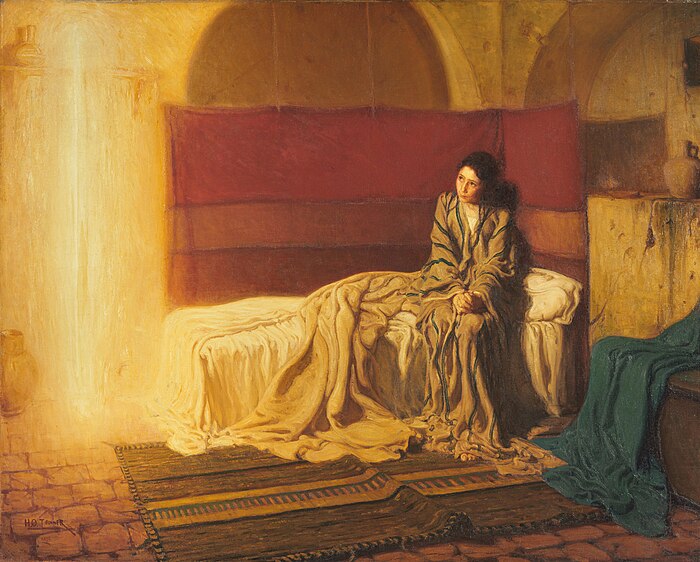
Henry Ossowa Tanner’s Annunciation offers another profound reflection. While not a Nativity painting, it captures the first moment of Christ’s coming. Mary sits on her bed, her blankets in rumpled and unorganized. Juxtaposed against the disheveled bed is Mary’s calm expression. Peaceful pondering exudes from her face. What can this angel’s greeting mean exactly? Perhaps it is not simply pondering, but something else. St. Luke uses the Greek word symballousa—“to throw or join together”. Perhaps she has fully let herself go, abandoning herself into the folds of God’s plans. She knows what just happened is significant; its meaning, though, unclear. All she can do is throw it together and hold it in her heart.
With two weeks left in Advent, there is plenty of time to receive its graces.
In Christ and St. Benedict,
Darryl De Marzio
Executive Director, Portsmouth Institute for Faith and Culture

Sorry, the comment form is closed at this time.