


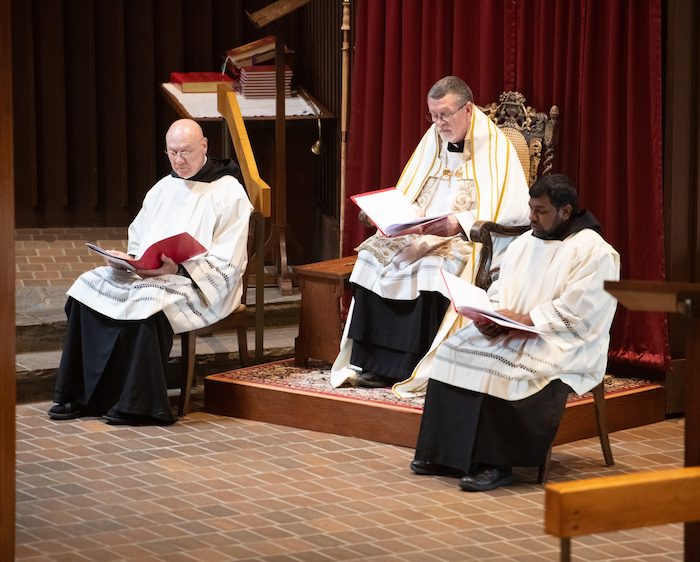
It is fitting to reflect on his Rule, for we live in a time not unlike St. Benedict’s, where institutional and political dissonance rings loudly. And lest we forget the cultural erosion, the trampling of the goods of tradition by elites and experts who prize a nebulous sense of “progress.”
It raises ultimate questions, too. Like St. Peter, we find ourselves asking “To whom shall we go?”
With respect to St. Peter, a better question might be How shall we go? “How” questions suggest practical answers, and St. Benedict offers a few practical “hows,” namely routine and Benedictine vows. By meditation on these two things, and by seeing how we might apply them to our lives, we might find paths to renewal, to meaning, and ultimately to Christ.
Routine
St. Benedict and his monks bear witness to the life-changing—yes, life-changing—power of routine. Basic, fundamental, perhaps even liturgical in character, routine turns chaos into order, shaping and molding not just our schedules, but our minds, desires, and souls. Today, when information, content, and quick-amusements force themselves into life’s every nook and cranny, Benedict shows us that routine’s guardrails pave the way for a peaceful daily existence. In 2024, that is, undoubtedly, a grace.
The Vows
It is worth meditating on the Benedictine order’s vows, too. Stability, obedience, and conversatio morum (‘fidelity to monastic life’) are decidedly different approaches to what Western life is like in 2024. They are total signs of contradiction and paths to freedom.
Stability
Data shows that Americans will move around 12 times in their lifetime. Different cities, different states, maybe even different countries. Setting down and picking up is no longer limited to military families. Moreover, when it comes to employment, it is said that millennials move jobs every 2-3 years. Gone are the days of staying at a company for forty years. To quote one of James Joyce’s characters in “The Dead”: “And you find that rootless existence appealing?” Many, it seems, have.
The Benedictine vow of stability is a commitment to living and praying at one particular monastery for the rest of their lives. It is a radical commitment, necessitating perseverance and patience, to time and place: time, as the monk dedicates his lifespan; place, insofar as he will not move again. (If they do move, it is by order from a monastic superior or by partnership with another community.)
Obedience
Volition. Freedom. Will. Our culture emphasizes the right to choose such that exercising one’s will is an end in itself, not a means by which to make a commitment. Ironically, those championing absolute freedom of the will seem unable to judge between options, unable to decide, commit, and then form a bond. The person is paralyzed by their boundless freedom.
Vowing obedience is the voluntary act of submitting to the authority not just of God, but to another human person. For Benedictine’s, it is the abbot or abbess. For married couples, they submit to one another, in a way forming a spousal will that governs their matrimony and family life. But deeper still, obedience, thought of in terms of its etymology, denotes a paying-attention-to, a listening- and responding-to the will of another, for “obedience” comes from the Latin “ob” (to) and “audire” (listen). So obedience is not simply a surrendering of the will, but a binding oneself to another such that we listen and dispose ourselves to the good authority of another.
Conversatio Morum
Conversatio morum often gets translated to “fidelity to monastic life.” “Conversatio” contains the Latin root converti, meaning to change or to convert. So for the Benedictine monk, there is the daily work of conversion, the letting oneself be changed by the ora et labora, the praying and working that is at the heart of Benedictine life.
Daily prayer and work is not exclusive to Benedictine monks. Both the monk and the layperson are called to attend to their respective communities and pray with them. Each one’s fidelity to their communal life, whether that be the monastery or family, calls them to attend to the daily invitations and encounters that are packed with grace.